

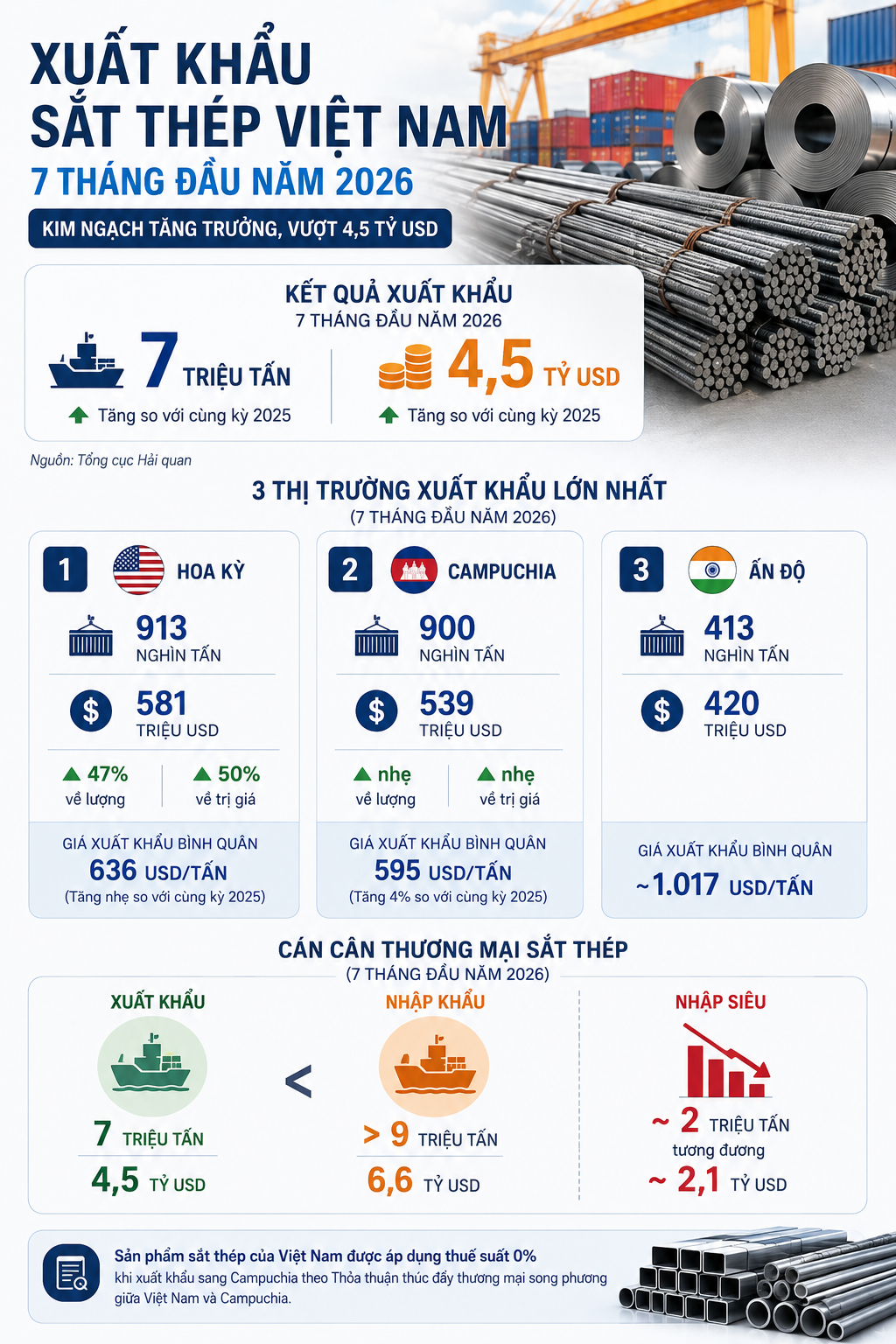
According to preliminary statistics from the General Department of Customs, in the first 7 months of 2026, Vietnam exported nearly 7 million tons of iron and steel, reaching a turnover of about 4.5 billion USD, increasing in both volume and value compared to the same period in 2025.
Export developments show that the market structure of the steel industry continues to shift. ASEAN remains an important consumption region, while the United States, India and several new markets recorded positive demand. However, Vietnamese steel enterprises are facing increasing pressure from trade defense measures, emission reduction requirements and price competition in the international market.
The United States is currently one of Vietnam's largest steel export markets. In 7 months, this country imported about 913,000 tons of iron and steel from Vietnam, worth more than 581 million USD, an increase of 47% in volume and 50% in value over the same period. The average export price is about 636 USD/ton.
Meanwhile, Cambodia imported more than 900,000 tons of Vietnamese iron and steel, equivalent to a turnover of more than 539 million USD, a slight increase over the same period. The average export price to this market reached about 595 USD/ton, an increase of about 4%.
India ranked next with nearly 413,000 tons, worth more than 420 million USD.
One factor supporting steel exports to Cambodia is that some Vietnamese iron and steel products enjoy a 0% tax rate under the bilateral trade promotion agreement between the two countries.
In general, the increase in exports in some major markets is helping the steel industry maintain turnover at billions of dollars, in the context that demand in some areas has not yet fully recovered.
Although exports maintain an increasing momentum, Vietnam's steel industry is still in a trade deficit. According to the Vietnam Steel Association, in the first 7 months of the year, Vietnam imported more than 9 million tons of iron and steel, with a total value of about 6.6 billion USD.
Thus, the amount of imported steel is about 2 million tons higher than exports, while the trade balance of steel industry goods has a deficit of about 2.1 billion USD.
This gap shows that domestic production still depends significantly on imported steel and raw materials. At the same time, export growth does not mean that the steel industry has completely improved the trade balance.
In the second half of the year, export prospects are forecast to continue to depend largely on global demand developments and trade policies of major markets.
The year 2026 is considered a period when trade defense measures around the world become more complicated. Global steel overcapacity is pushing many countries to increase protectionist measures to protect domestic production.
In the United States, imported steel is under pressure from tariff policies under Section 232 of the Trade Act, with tariffs up to 50% on some products. Along with that, many trade defense cases continue to be initiated against Vietnamese steel products.
Another challenge comes from environmental requirements. Major markets are increasingly tightening sustainable development standards, reducing greenhouse gas emissions and applying cross-border carbon adjustment mechanisms.
Notably, the European Union's Carbon Border Adjustment Mechanism (CBAM), forces steel manufacturers to pay more attention to emissions throughout the entire production process. This is significant pressure on Vietnamese businesses in the context that the industry is still dependent on imported raw materials and needs more time to convert technology towards low emissions.
In the context of global economic uncertainty, prolonged geopolitical conflicts and increasing trade competition, maintaining the export growth momentum in the first 7 months of the year is a positive sign. However, the ability to grow in the final months of the year will depend not only on market demand but also on the ability of businesses to adapt to increasingly strict trade barriers and carbon standards.
Source:https://cafef.vn/